

Cachepot
a study in contact-tracing an idea

This is a story in which almost nothing happens. But somehow so much happens. An ecopot saucer had come to be firmly stuck inside a cobalt Wedgwood Jasperware cachepot. This is the story of how I was able to loosen it without breaking the cachepot.
Solving a problem that feels relatively trivial in the first place can be a lonely undertaking, but quickly I found myself drawing upon ideas from people who were very distant from me, but who, in that moment, brought me closer to getting the saucer unstuck.
I keep coming back to wanting to tell this story because I’m fascinated and encouraged by how fluid and nuanced the process of collaboration can be, and how it does not rely on actually working in the presence of another person, or even knowing that person directly.
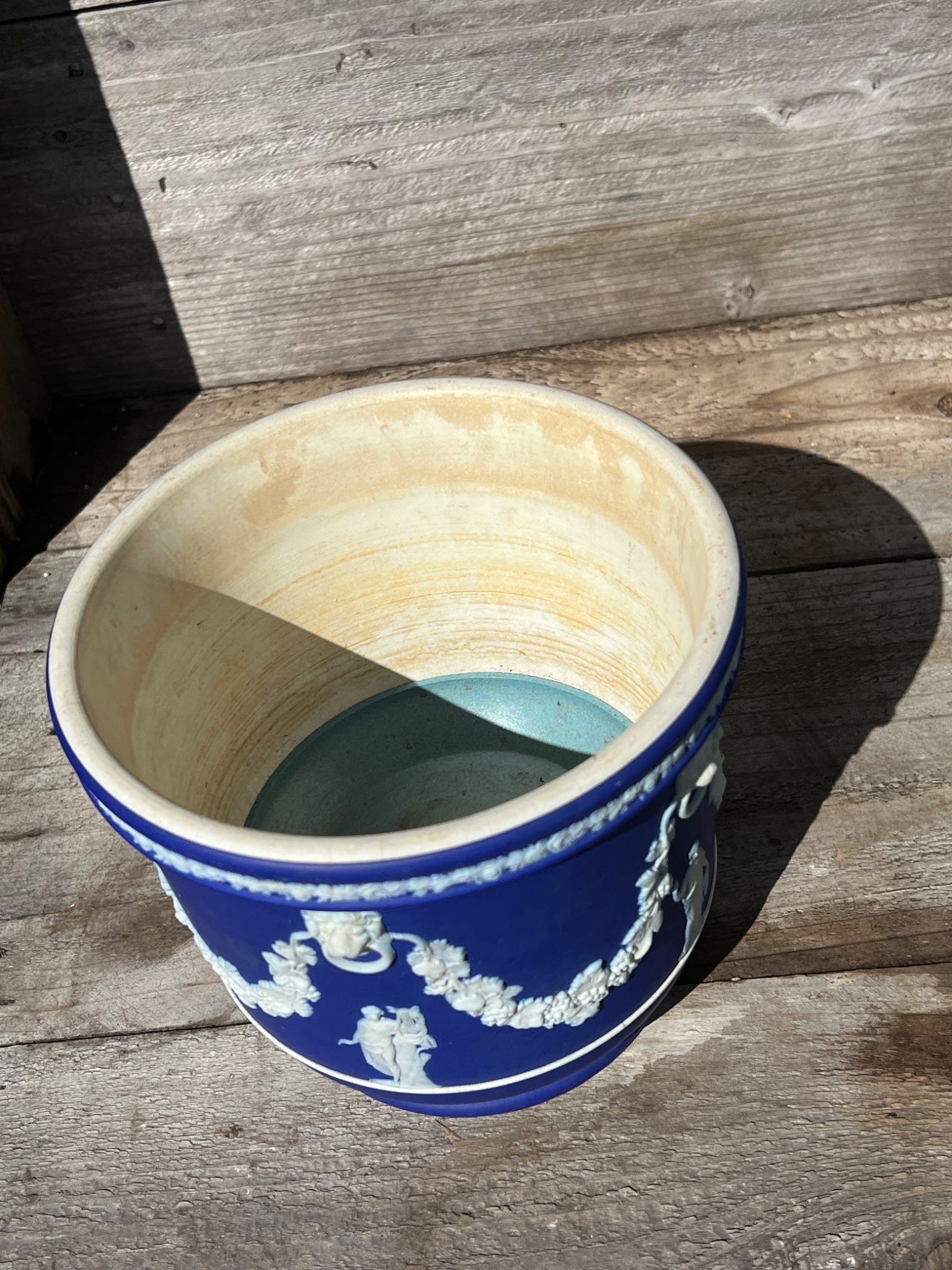
Before we even set out on this story, already the question arises: why was the saucer inside the cachepot? Isn’t a cachepot itself a glorified saucer of sorts?
My plan was to place the saucer upside down at the bottom of the cachepot to raise the inner pot about an inch. I’d pictured the saucer sitting comfortably at the bottom of the pot, able to move freely, able to lift slightly to allow for any water that might drain out of the inner pot, but it turned over in the process, creating a little vacuum sub-basement in the pot.
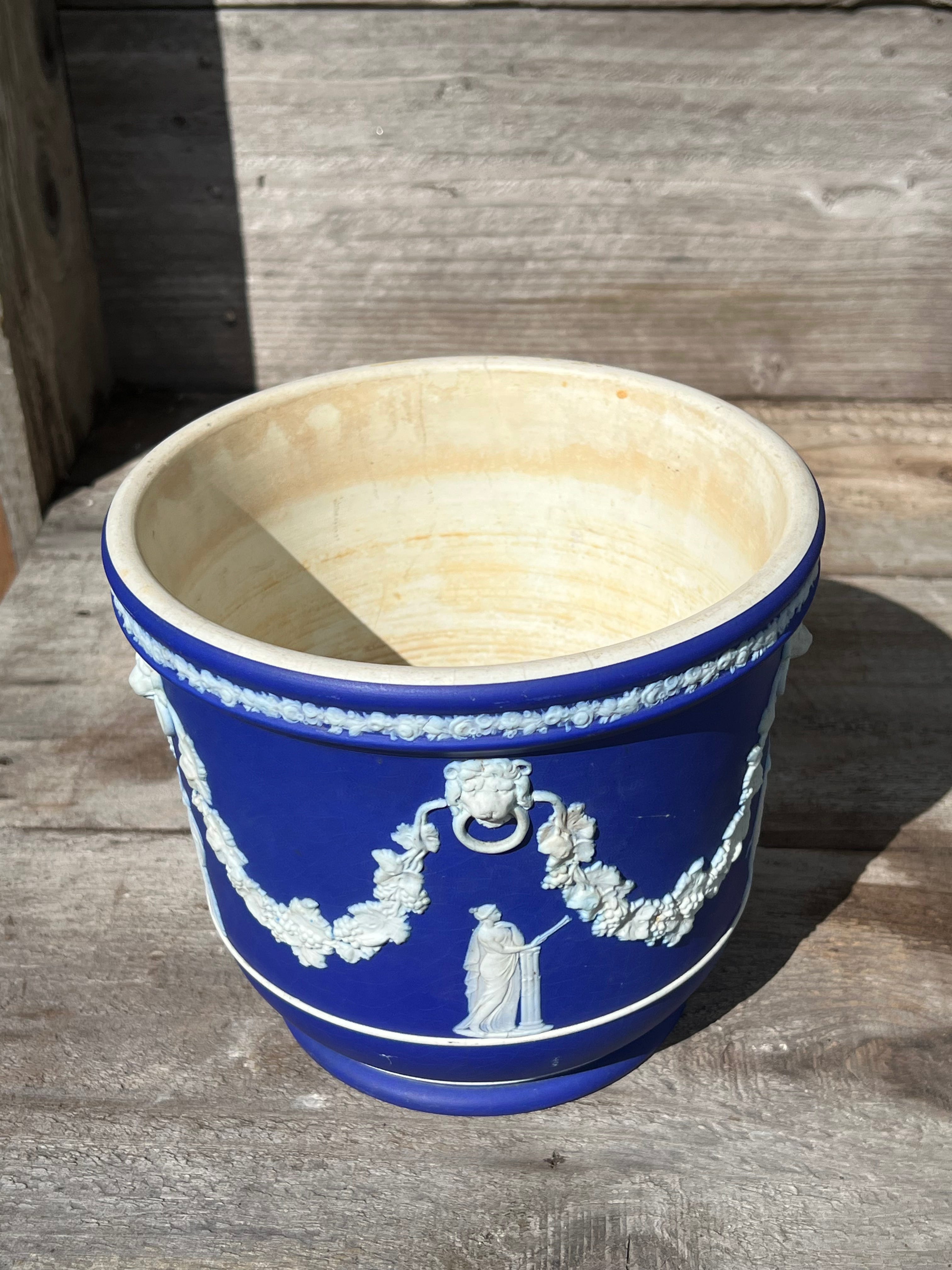
Let’s pause for a few words about cachepots: a cachepot is a pot with no drainage hole. It’s meant to be an outer pot holding a smaller pot with drainage holes.
The whole premise of a cachepot is that the more beautiful cachepot “hides” (from the French verb “cacher,” to hide) the more ordinary nursery pot. I’d always understood the “cache” of cachepot in the sense of a reserve, a temporary holding place, in this case, a place to cache water. I’d always understood the sense of cache to be more about the way the pot creates a “cache” holding whatever water overflows the inner plant. I prefer that sense of cache because I don’t think the inner pot needs hiding so much as it just needs support. I also think it’s wrong give the outer pot the role of hiding the inner one. Let them each be sufficient unto themselves.
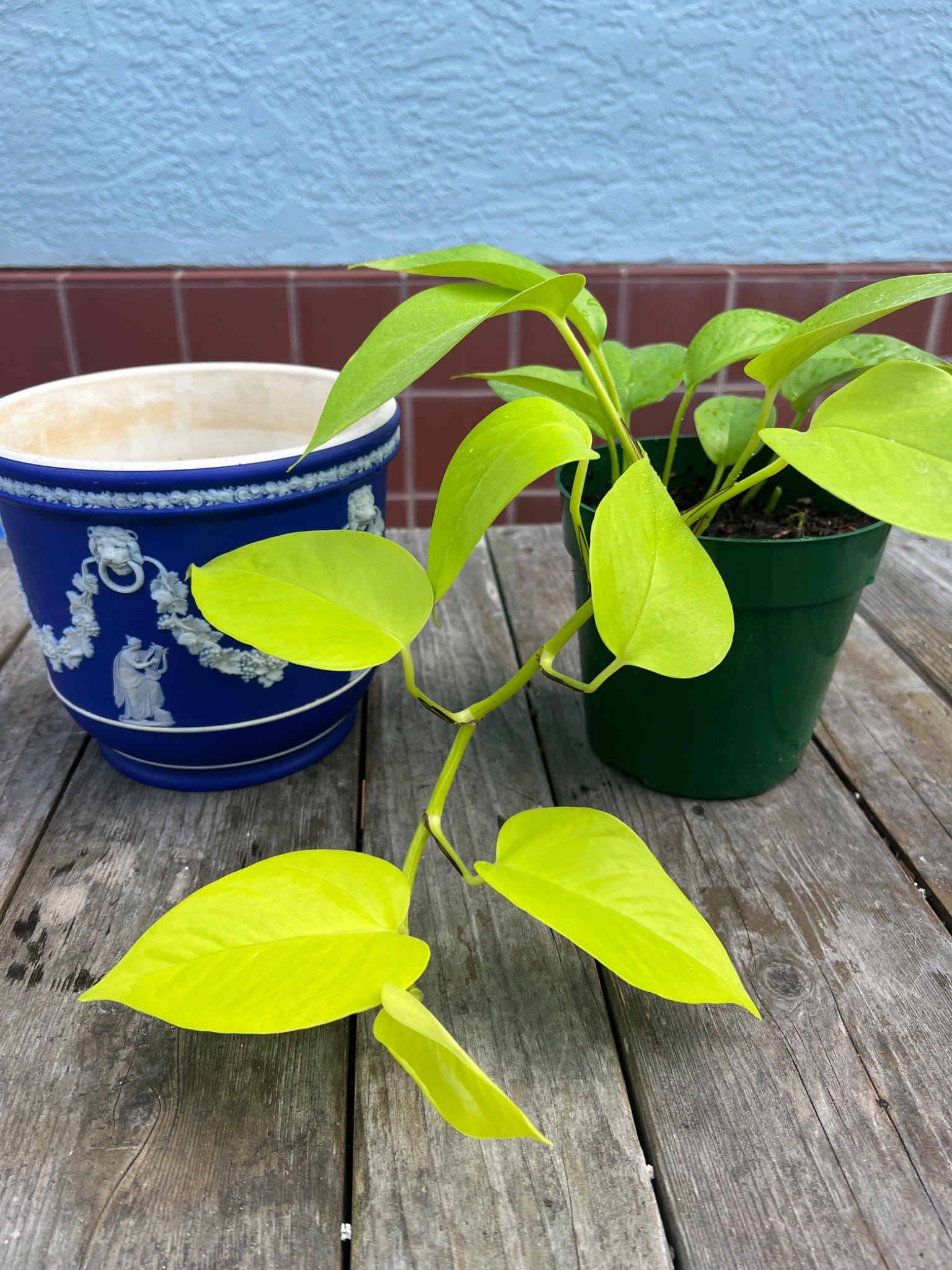
It pains me to see a plant planted directly into a cachepot, with no inner pot. No chance for drainage and for air to move through. I see this frequently with succulents who especially do not like wet roots.
It’s hard not to want to repot all the sad succulents I encounter in cafes, yoga studios, and office buildings barely hanging on, desert plants who have somehow found themselves in tiny dimly lit swamps.
The changing room at my former gym has several of these under fluorescent lights and each time I passed by them I told myself, just do the things you can do.
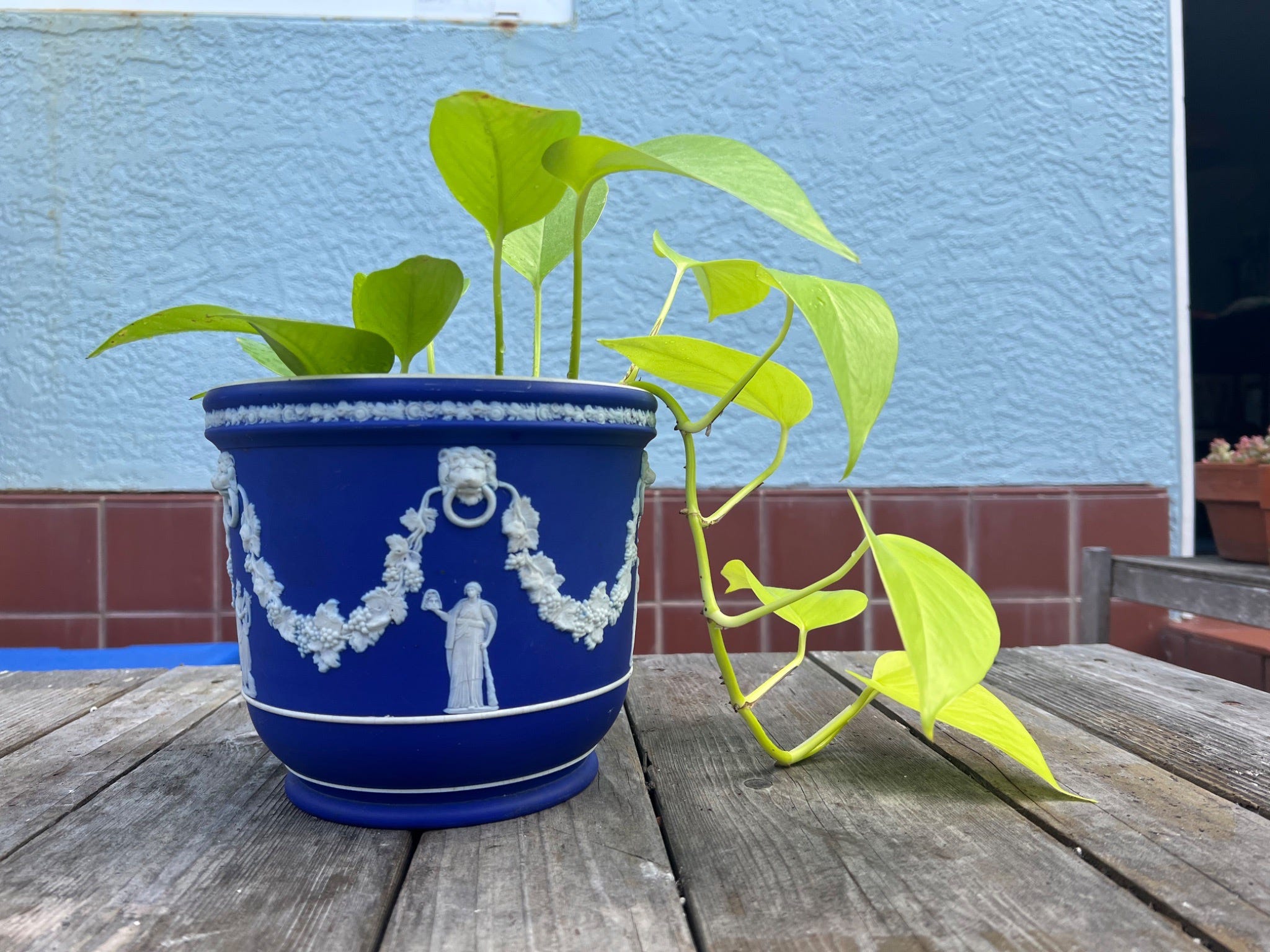
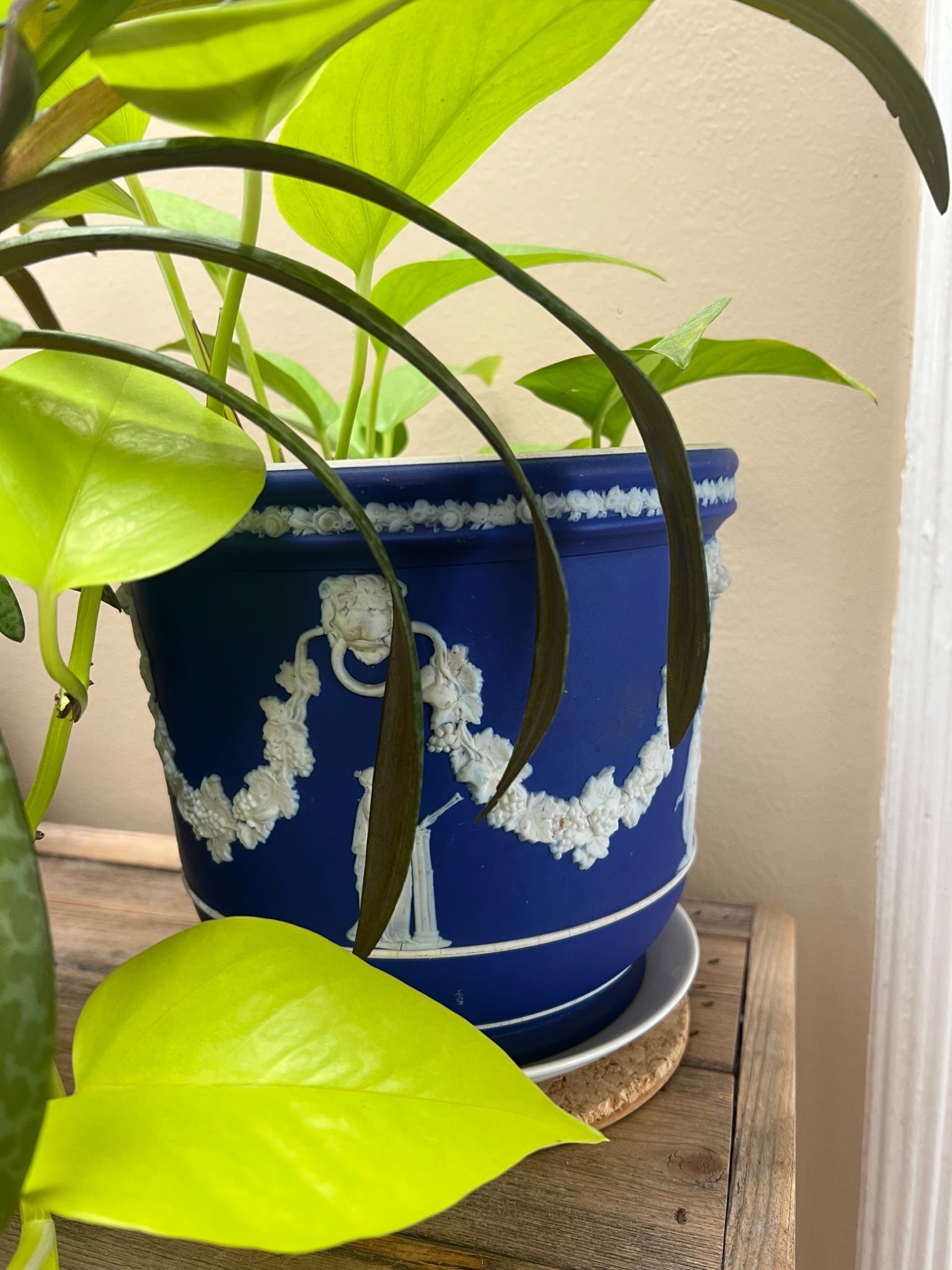
So when this elegant Wedgwood pot came along after my partner’s mother died two Christmas eves ago, I wanted to treat it with care. I would follow Gertrude Jekyll’s guidelines and use it like the proper jardiniere it was!
And then within a few minutes the inner saucer was stuck. I could have just let it stay there, out of view, with the inner pot propped on top of it but it felt so wrong to leave this stagnant air pocket to just lurk there under the plant.
Just a firm tap, as I might have done with a terra cotta pot, might have dislodged it, or I might have worked something down the side of it and pry it up. Both of these were too risky.
I had to come up with a way to loosen the saucer.
My first thought was to put water in it. As it contracted, it would pull away, I thought, and this would offer the tiniest bit of give, which was all I needed. This proved counterproductive and only made the pot swell and made the saucer tighter. I put it out in the sun to dry. But an afternoon of sun later, I still couldn’t budge it.
I thought of drilling a hole in the saucer to allow some air to break the seal, and to release any water that was now stuck under there. But a regular drill would be too potentially dangerous for the pot. Perhaps a finer drill like a Dremel might have worked. But I don’t have a Dremel.
I remembered that Alys Fowler, one of my deepest sources of garden inspiration, made little makeshift watering bottles by heating up an awl and then putting holes in the top of a plastic bottle. I have made many of these bottles for watering seedlings since first coming upon that idea in her book, Garden Anywhere.
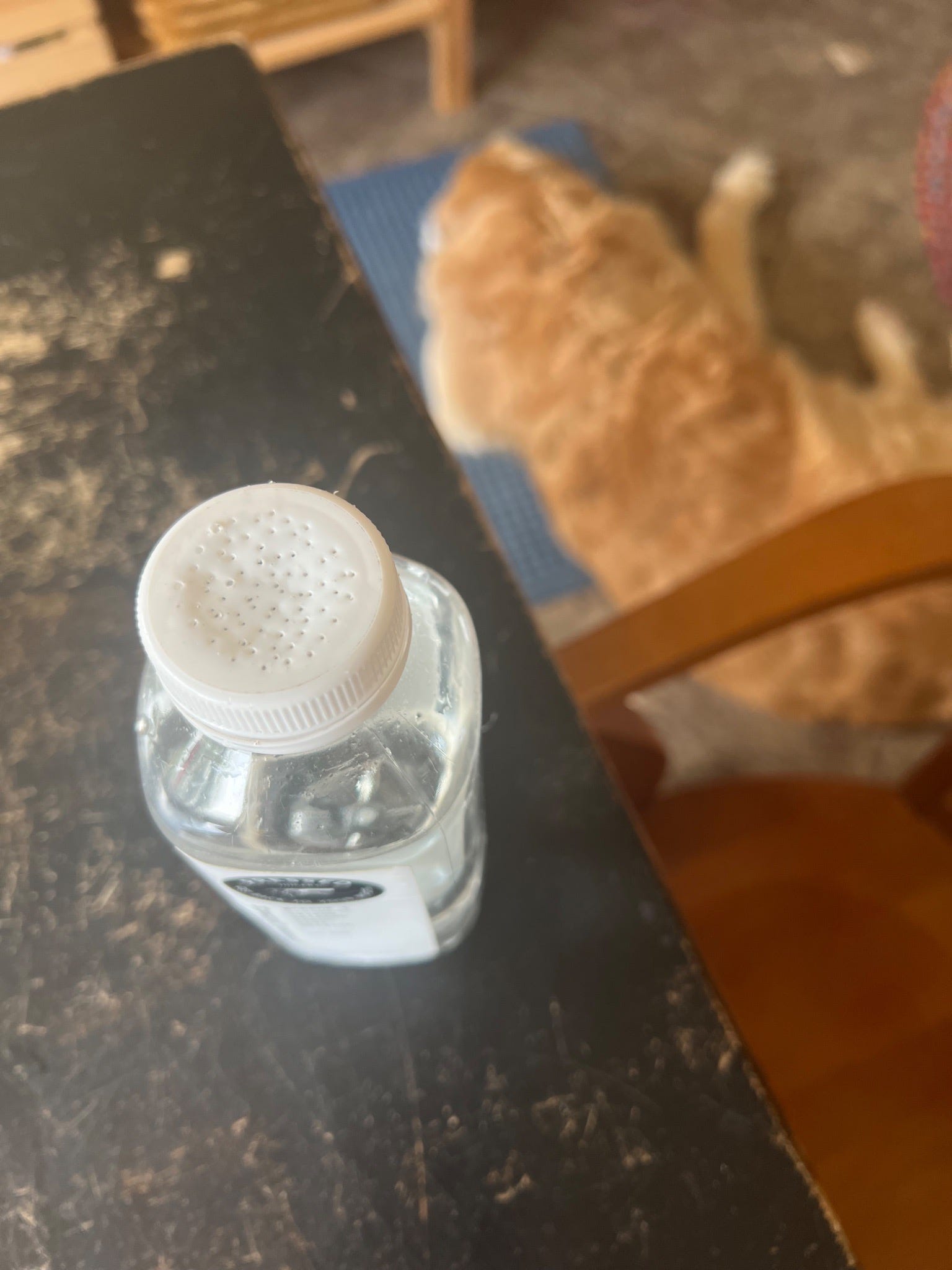
So I thought, I’ll do that with this ecopot saucer. Along with this specific vision of the hot awl going through the saucer, I was getting a sense not specifically of an image, but more of a kind of resonance, an imprint, a trace of a feeling I got when reading a passage more than twenty years ago in Elizabeth King’s book, Attention’s Loop: A Sculptor’s Reverie on the Coexistence of Substance and Spirit. She’s describing her father solving a delicate problem. I’ve thought about this passage so many times since reading it, though the actual details of it had gotten a bit blurry.
What I recalled was that he sliced through something extremely small and fragile with an actual hair. But here is what she actually wrote:
One day my father, a physicist, told me about a copper crystal he had
inherited from a scientist at Oak Ridge. It was grown in the lab to be struc-
turally perfect, having only 3,000 dislocations per cubic centimeter instead
of the normal 10,000,000. If you held it between your thumb and forefinger
and squeezed it even slightly, you’d ruin it. Dad was wondering how he
could slice a thin wafer (only a few molecules thick), off this crystal, so he
could examine it with the neutron beam: “What if I just drape a thread
over it, and put each end of the thread in an acid, so that it will slowly cut
through the copper without exerting any pressure?”
My process wouldn’t require acid, but there was something in her father’s mindset – and in the way she evoked it – and the way he introduced another tool, coming at the problem from an oblique angle that offered me company in this moment.
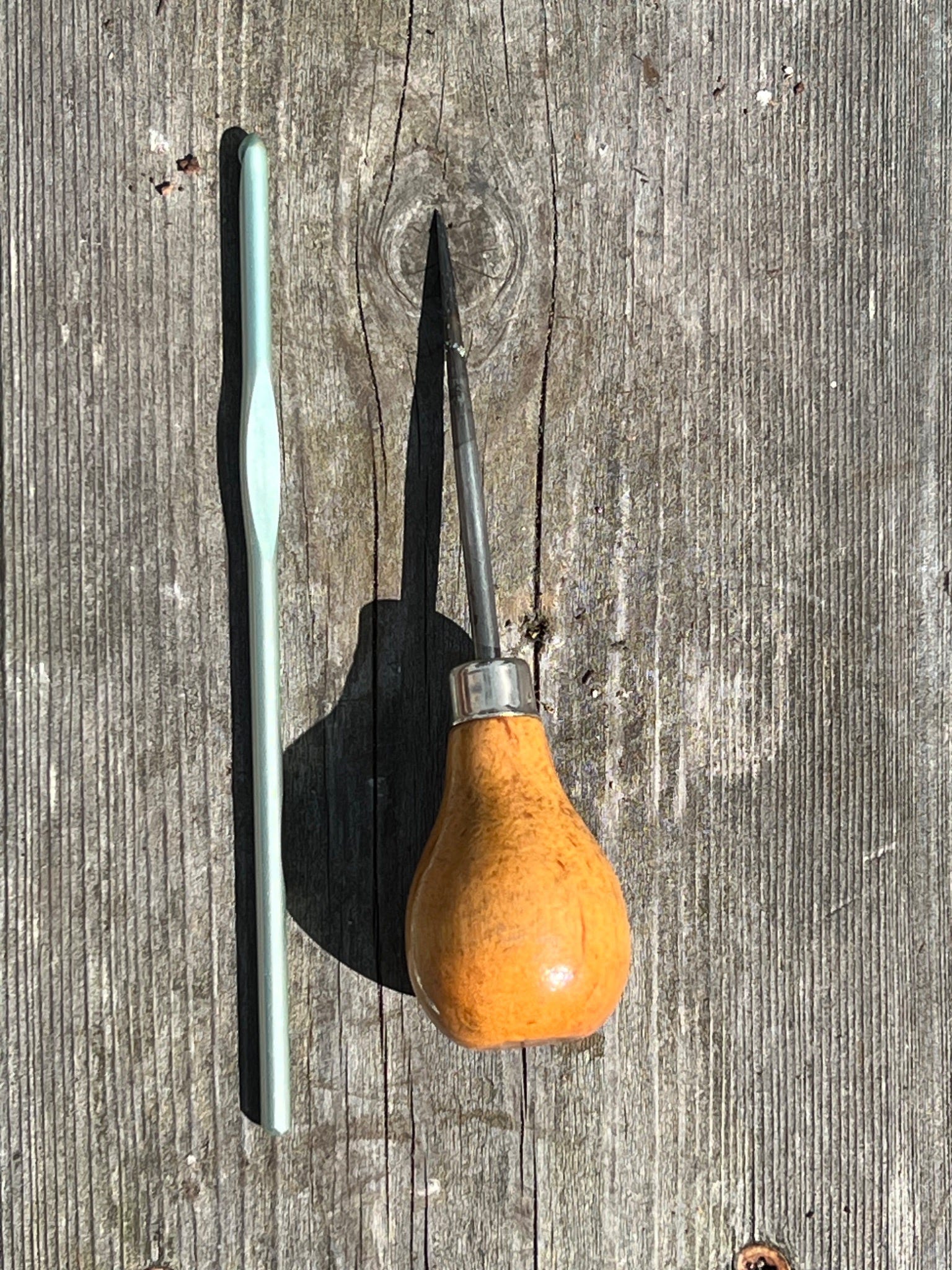
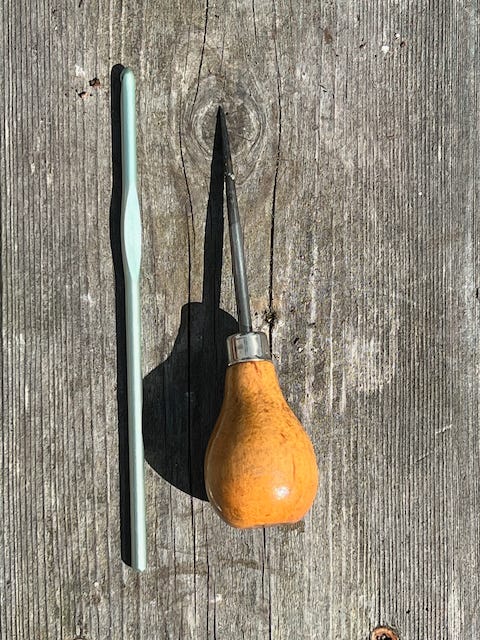
And so I looked for my awl. I hadn’t used it in a while. I actually have several sizes. They’re useful in bookbinding. In using an awl I am always in some way bringing to mind Peter Madden and the bookbindiing class I took with him in the off-season in Provincetown. We learned the pamphlet stitch, which can require as few as three holes. Three holes and a bit of linen thread and you can turn a few pieces of paper into a book! I have taught the pamphlet stitch to many students in my writing classes and they’ve in turn made small books, fascicles, like Emily Dickinson.
I heated up the awl by holding a match to the point.
I slowly put pressure on the needle tip and and it made a small hole. This released any pressure that might have been under the saucer, and also if there was any water left in it, it could come out.
I moved the awl around a little bit to try to lift the saucer out, but an awl, is by definition pointed, so what I now needed was something that could catch under the saucer, something with a little hook. Maybe I could bend back a fork tine with a pliers and then bend the tip of the fork tine.
And then it came to me. This already exists: it’s called a crochet hook. So I got a tiny one and I just gently slipped it through the saucer which no longer had its vacuum grip, and voila, it was done. The saucer was free.
The pot was intact. I was…exactly where I’d started. But also, so much had happened in the interval!
And, true, I did now have a saucer with a hole in it, which completely undoes its primary purpose, but no doubt there will be a new use in the garden for that.
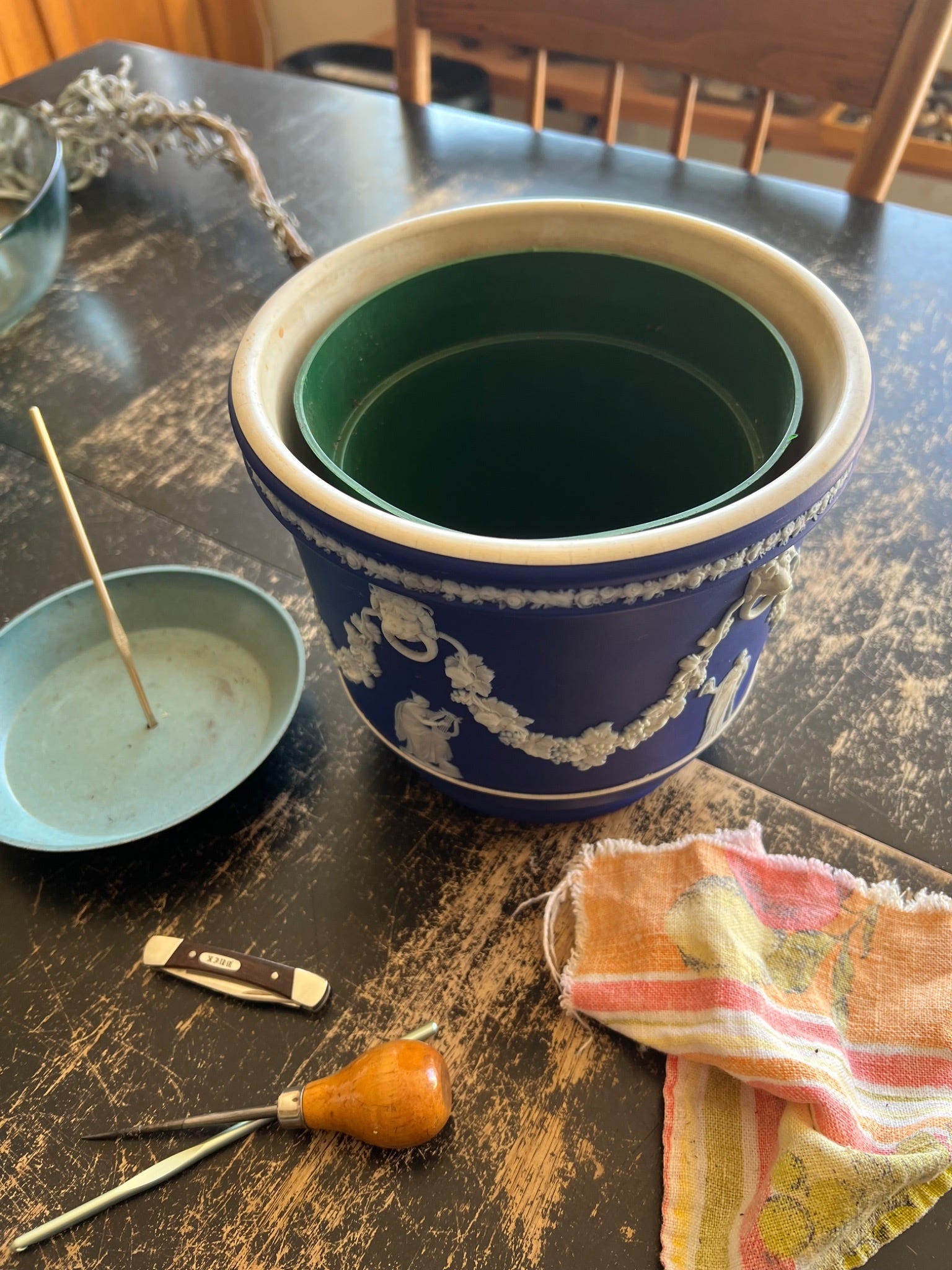
Being in the garden is such an ongoing study of relatedness, as in all the plants that hold their lineage of having been given to me as cuttings or seedlings from friends. And in this moment with the stuck saucer it struck me how many people had been present with me in releasing it.
And in this moment of lifting the saucer out of the cachepot without harming it, everyone was required, and no one even knew how much they had helped.
upcoming workshops:
Starting this Wednesday, June 3, for 4 weeks, Erica Ehrenberg and I will be teaching our workshop, Nothing is Hidden: Explorations in Buddhist Thought, Psychoanalysis, & Literature. We have one space left! | 4 Sessions, Wednesdays | 9-10:30 PST June 3, 10, 17, 24, online.
Stanza: A Generative Writing Workshop: Tuesdays, 4-5:30 PST | ongoing. online.
Contemplative Tending: Soji as Creative Practice, Sunday, June 14, 10 - 12:30 PST.
Please message me below if you’d like to register for any of these workshops.